
"Eastern Mountains"
2000 article(s) found

Introduction to the characteristics of Ecuador Fine Coffee Flavor Manor
Ecuador is divided into the western coast, the central mountains, the eastern Amazon River basin and the four central regions of the Galapagos Islands, with diverse climatic conditions. The western coastal plain belongs to the tropical rain forest climate, with an average temperature of 23-25 ℃. The central Andes. The intermountain basin in this area belongs to the savanna climate, and the mountain belongs to the subtropical forest climate, with perennial snow above 4000 meters above sea level. Annual average decline

Flavor and taste characteristics of coffee manor in Ecuador introduction to Santa Cruz Manor
Ecuador is divided into the western coast, the central mountains, the eastern Amazon River basin and the four central regions of the Galapagos Islands, with diverse climatic conditions. The western coastal plain belongs to the tropical rain forest climate, with an average temperature of 23-25 ℃. The central Andes. The intermountain basin in this area belongs to the savanna climate, and the mountain belongs to the subtropical forest climate, with perennial snow above 4000 meters above sea level. Annual average decline

Nicaragua coffee beans variety characteristics flavor description grinding scale introduction
Nicaragua coffee bean species characteristics Flavor Description Grinding Scale Introduction Central Colombia is divided into several valleys by three north-south vertical mountains, of which the central and eastern mountains are the main coffee producing areas. The coffee is named after the market where it is distributed. In the Central Mountains, Medellin, Armenia and Manizales are located.

Basic knowledge of boutique coffee Colombian coffee producing area
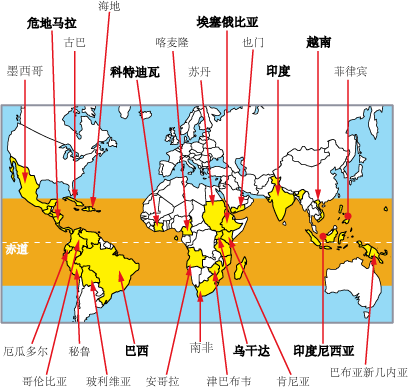
[Columbia (Colombia) Coffee] is the second largest producer of coffee in the world, accounting for about 12% of the world's annual output, although far lower than the first Brazil's 30% to 35%, but most are high-quality mountain-washed beans. Central Colombia is divided into valleys by three north-south longitudinal mountains, of which the central and eastern mountains are the main producers of coffee. Coffee collection here

Introduction to Galapagos Coffee in Ecuador Coffee Manor
The Republic of Ecuador is located in northwestern South America. It is bordered by Colombia in the northeast, Peru in the southeast and the Pacific Ocean in the west. It covers an area of 256370 square kilometers and the coastline is about 930km long. The equator runs north of the border, and Ecuador means the Spanish equator. [3] Climate Ecuador is divided into the western coast, the central mountains, the eastern Amazon basin and the Galapagos Group

Fine coffee origin introduction: Colombian boutique coffee beans Colombian coffee characteristics Columbia
It is the second largest coffee producer in the world, accounting for about 12% of the world's annual output, which is much lower than that of Brazil, which is 30% to 35%, but most of them are high-quality mountain-washed beans. Central Colombia is divided into valleys by three north-south longitudinal mountains, of which the central and eastern mountains are the main producers of coffee. The coffee here is named after the distribution market, and it is beautiful in the Central Mountains.

Basic knowledge of boutique coffee beans Colombian coffee producing area
[Columbia (Colombia) Coffee] is the second largest producer of coffee in the world, accounting for about 12% of the world's annual output, although far lower than the first Brazil's 30% to 35%, but most are high-quality mountain-washed beans. Central Colombia is divided into valleys by three north-south longitudinal mountains, of which the central and eastern mountains are the main producers of coffee. Coffee collection here

An introduction to the manor producing area with low ripe fruit aroma and the flavor of fine Ugandan coffee beans.
Climate: although Wu is located on the equatorial line, due to its high terrain, vertical and horizontal rivers and dotted lakes, it has abundant rainfall, luxuriant plants and spring all the year round, and was once regarded by Churchill as the Pearl of Africa. The annual average temperature is 22.3℃. The temperature was the highest in October with an average of 23.55 ℃ and the lowest in June with an average of 21.4℃. The annual rainfall in most areas is between 1000 and 1500 mm.

Brief introduction of Colombian Fine Coffee beans taste characteristics of Colombian Fine Coffee
It is the second largest coffee producer in the world, accounting for about 12% of the world's annual output, which is much lower than that of Brazil, which is 30% to 35%, but most of them are high-quality mountain-washed beans. Central Colombia is divided into valleys by three north-south longitudinal mountains, of which the central and eastern mountains are the main producers of coffee. The coffee here is named after the distribution market, and it is beautiful in the Central Mountains.

Introduction to the producing countries of fine coffee beans from Colombia
[Columbia (Colombia) Coffee] is the second largest producer of coffee in the world, accounting for about 12% of the world's annual output, although far lower than the first Brazil's 30% to 35%, but most are high-quality mountain-washed beans. Central Colombia is divided into valleys by three north-south longitudinal mountains, of which the central and eastern mountains are the main producers of coffee. Coffee collection here

Colombian Coffee Origin introduces Colombian Fine Coffee characteristics of Colombian Coffee
Colombia is the second largest producer of coffee in the world, accounting for about 12% of the world's annual output, which is much lower than that of Brazil, which is 30% to 35%, but most of them are high-quality mountain-washed beans. Central Colombia is divided into valleys by three north-south longitudinal mountains, of which the central and eastern mountains are the main producers of coffee. The coffee here is named after the distribution market, in the Central Mountain.

Description of characteristics and Flavor of Yunnan Tieka Coffee beans introduction of varieties in taste producing areas
Yunnan Tieka Coffee Bean characteristics and Flavor description the varieties of Yunnan are high in the northwest and low in the southeast, with an abnormal elevation difference. Yunnan belongs to the southern extension of the Qinghai-Tibet Plateau, and the topography is bounded by the wide valleys of Yuanjiang Valley and the southern section of Yunling Mountains. divided into east and west. The eastern part is the plateau of eastern and central Yunnan, the topography is undulating in small waves, with an average elevation of about 2000 meters above sea level.

Flavor description of Indonesian Sulawesi Coffee introduction to the production area of Grinding scale of varieties
Indonesia Sulawesi Coffee Flavor description varieties Grinding scale production area introduction Sulawesi Island (Celebe) is a large island in eastern Indonesia. The island is peculiar in shape, extending from four peninsulas to the north, northeast, southeast and south. With more mountains and deep valleys and less plains, it is the island with the largest proportion of mountainous areas in Indonesia. Toraja on Sulawesi Island

Fruit aroma of Ecuadorian Coffee Manor flavor and taste characteristics of boutique coffee beans
Ecuador is divided into the western coast, the central mountains, the eastern Amazon River basin and the four central regions of the Galapagos Islands, with diverse climatic conditions. The western coastal plain belongs to the tropical rain forest climate, with an average temperature of 23-25 ℃. The central Andes. The intermountain basin in this area belongs to the savanna climate, and the mountain belongs to the subtropical forest climate, with perennial snow above 4000 meters above sea level. Annual average decline

Start with coffee beans (42)-Africa-Zimbabwe
High-quality Arabica coffee beans cater to the needs of foodies. Coffee cultivation in Zimbabwe began relatively recently, in the 1960s, when farmers in southern Africa set up coffee plantations. Coffee cultivation in Zimbabwe is mainly concentrated in the eastern highlands near Mozambique, mainly by Chimanima
Coffee beans Africa Zimbabwe
High-quality Arabica coffee beans cater to the needs of foodies. Coffee cultivation in Zimbabwe began relatively recently, in the 1960s, when farmers in southern Africa set up coffee plantations. Coffee cultivation in Zimbabwe is mainly concentrated in the eastern highlands near Mozambique, mainly by Chimanima
Coffee producing area Coffee introduction to Zimbabwe
High-quality Arabica coffee beans cater to the needs of foodies. Coffee cultivation in Zimbabwe began relatively recently, in the 1960s, when farmers in southern Africa set up coffee plantations. Coffee cultivation in Zimbabwe is mainly concentrated in the eastern highlands near Mozambique, mainly by Chimanim
The characteristics of Arabica beans the coffee producer Zimbabwe coffee beans Zimba
Zimbabwe's high-quality Arabica coffee beans cater to the needs of foodies. Coffee cultivation in Zimbabwe began relatively recently, in the 1960s, when farmers in southern Africa set up coffee plantations. Coffee cultivation in Zimbabwe is mainly concentrated in the eastern highlands near Mozambique, and the highlands are mainly made up of Chimanimani
Zimbabwe coffee high-quality Arabica coffee beans to meet the needs of gourmets
High-quality Arabica coffee beans cater to the needs of foodies. Coffee cultivation in Zimbabwe began relatively recently, in the 1960s, when farmers in southern Africa set up coffee plantations. Coffee cultivation in Zimbabwe is mainly concentrated in the eastern highlands near Mozambique, mainly by Chimanima

Zimbabwe coffee high-quality Arabica coffee beans to meet the needs of gourmets
High-quality Arabica coffee beans cater to the needs of foodies. Coffee cultivation in Zimbabwe began relatively recently, in the 1960s, when farmers in southern Africa set up coffee plantations. Coffee cultivation in Zimbabwe is mainly concentrated in the eastern highlands near Mozambique, mainly by Chimanima